
Marshall County Criminal Court Records
A criminal court record is the court-level file created after the prosecutor files charges or the case otherwise enters District Court. In Marshall County, the Clerk of the District Court maintains criminal files as part of the Kansas District Court case system. The record may show the State of Kansas as a party, the defendant, charging documents, bond orders, attorney appearances, plea entries, motions, hearing notices, disposition, sentencing orders, probation terms, and journal entries.
The Marshall County Attorney is the local prosecutor for crimes committed within the county and works with state, local, and sometimes federal law enforcement. That office's charging role is different from the clerk's record role. The County Attorney files and handles prosecutions; the Clerk of the District Court maintains the case record after filing.
The County Attorney page appears in this Marshall County Attorney screenshot.
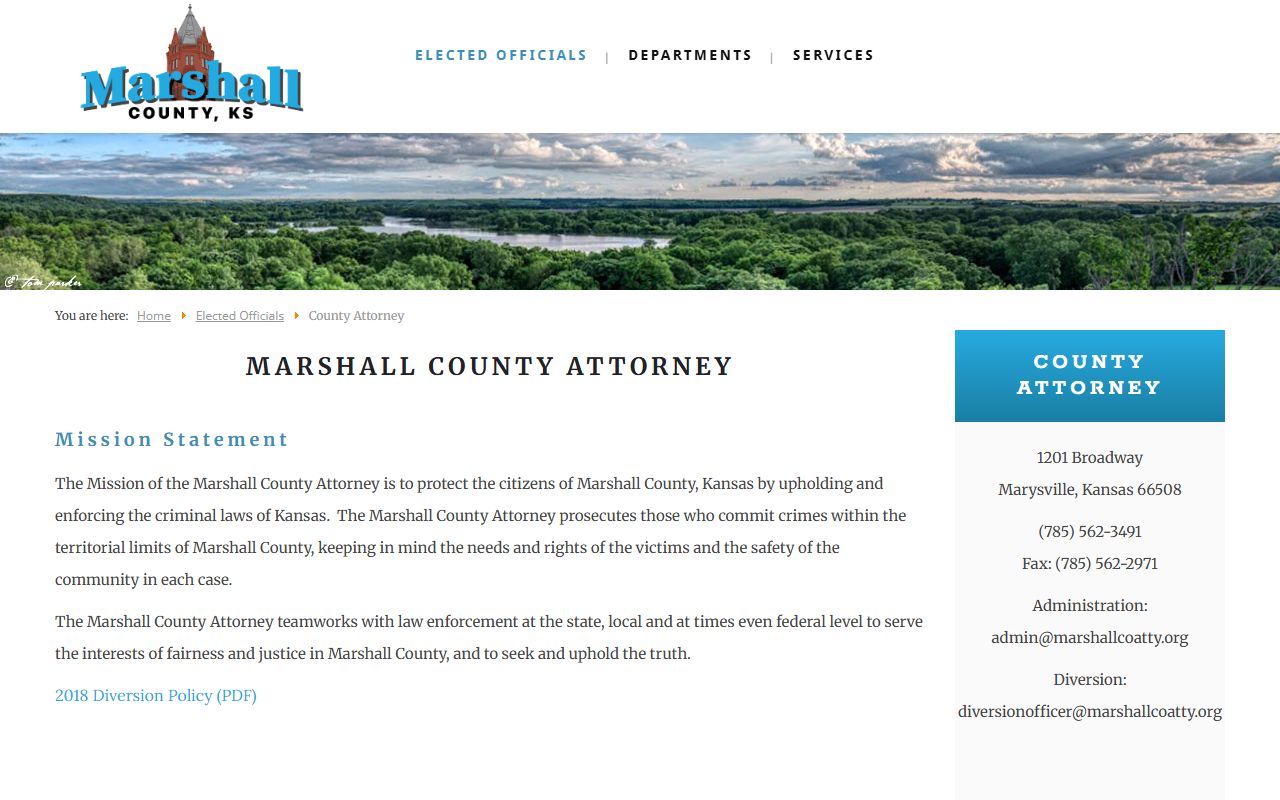
That source supports the local prosecution path, while the District Court record remains the source for court filings, hearings, disposition, and sentence.
Search Marshall County Criminal Records
Public criminal case information may be searched through Kansas CaseSearch when the case is public and the portal allows access. The portal advertises search by case number, party name, business name, citation, and other criteria available for the user's role. The free public search does not require an account for general use, while expanded access is a separate registered path for eligible users.
- Open Kansas CaseSearch and accept the portal terms if required.
- Search by defendant name, case number, or citation if the case began from a citation.
- Use Marshall County or 22nd Judicial District filters when available.
- Open the public case summary and review charges, docket entries, hearings, disposition, and sentence fields if shown.
- Submit the Marshall County District Court records request form for certified copies or documents not available online.
Criminal court records are not the same as booking records. A jail booking may show arrest facts, custody status, or hold information, while the court file shows what was filed in court and how the case moved. For the arrest-to-charges path, use the Marshall County arrest records and court charges page.
Marshall County Criminal Case Flow
Criminal court records become clearer when read as a sequence. A filed complaint or information starts the court case. The arraignment records the defendant's formal response. Pretrial entries show motions, discovery, settings, continuances, and orders. Later entries show whether the matter ended by plea, trial, dismissal, acquittal, diversion, or another disposition. Sentencing entries show what the judge ordered after conviction or plea.
Case flow: Charges Filed › Arraignment › Pretrial / Motions › Plea or Trial › Disposition › Sentencing
| Stage | What Happens |
|---|---|
| Charges filed | The complaint or information is filed by the prosecution and becomes part of the District Court case. |
| Arraignment | The court handles the formal reading or notice of charges and records the defendant's plea. |
| Pretrial / motions | Attorneys file motions, notices, discovery-related papers, and requests for rulings or settings. |
| Plea or trial | The case resolves through a plea, bench or jury trial, dismissal, acquittal, or other court action. |
| Disposition | The record shows the current or final result for each charge or the case as a whole. |
| Sentencing | The court records jail, prison, probation, fines, costs, restitution, treatment, or other ordered terms. |
Marshall County Court Services can matter after conviction. The county Court Services page says officers supervise adult and juvenile offenders convicted of misdemeanors and some felonies who are placed on probation, prepare presentence reports, and supervise some defendants released on bond.
Marshall County Criminal Record Fields
A criminal court record shows the court's version of the case, not every law-enforcement event. The record may include filed charges, but the filing history, hearings, pleas, rulings, disposition, and sentence are what make it a criminal court record. Some public entries may appear in CaseSearch. Full copies, certified copies, or older documents may require the Marshall County District Court Request for Records form.
| Field | What It Shows |
|---|---|
| Case number | The Kansas district court case identifier for the Marshall County criminal case. |
| Defendant | The person charged in the court case, with protected identifiers redacted from public copies. |
| Prosecutor | The attorney for the State, usually the Marshall County Attorney for local prosecutions. |
| Charges | The offenses filed in court, with amendments, reductions, dismissals, or added counts reflected by docket activity. |
| Bond | Bond amount, type, or conditions when public and entered in the case. |
| Plea | Guilty, not guilty, no contest, or another formal response recorded by the court. |
| Motions and orders | Requests to the judge and court rulings, including suppression, discovery, continuance, and scheduling orders. |
| Disposition | The result, such as guilty, dismissed, acquitted, diverted, amended, or otherwise resolved. |
| Sentence | Jail, prison, probation, costs, fines, restitution, treatment, or other judgment terms. |
Marshall County Charges vs Convictions
A charge is an accusation filed in court. A conviction is a result after a guilty plea, no-contest plea accepted by the court, or finding of guilt. Criminal court records may show charges that were amended, reduced, dismissed, or ended in acquittal. Treating every charge as a conviction misreads the court file and can harm the person named in the record.
| Charge | Conviction | |
|---|---|---|
| Meaning | An allegation filed by the prosecutor in court. | A court result based on plea or finding of guilt. |
| Where it appears | Complaint, information, docket entries, and amended filings. | Disposition, journal entry, sentencing order, and judgment records. |
| Can it change | Yes. Charges may be amended, reduced, dropped, or dismissed. | It may later be appealed, corrected, set aside, or expunged if eligible. |
| How to verify | Read later docket entries and charge status. | Look for disposition and sentence, or request a certified copy. |
When the needed question is all court case categories, not just criminal cases, use the main Marshall County court records path.
Access Marshall County Criminal Records
Kansas public access laws support inspection of public records, but they do not open records that are closed by court rule, statute, expungement, or sealing order. K.S.A. 45-215 identifies the Kansas Open Records Act. K.S.A. 45-220 addresses procedures for access and copies, including certification on commercial use of lists. The Marshall County District Court records request form follows that framework by asking requesters to certify proper use of names and addresses.
For local criminal court records, the practical channels are Kansas CaseSearch, the public access computer in the Clerk of the District Court office, and the written Request for Records PDF. The District Court FAQ says copies requested after using the public access computer are provided, if possible, within 3 days. If the record is off-site, equipment is unavailable, or another reason prevents prompt copying, the requester receives a written explanation for the delay.
Key statutes: Kansas open-records sections support access to public records, while court confidentiality rules still limit juvenile, sealed, and expunged files.
Marshall County Sealed Records
Sealed and expunged records are not the same. A sealed record is removed from ordinary public inspection by law or court order. An expungement limits public access to eligible conviction, arrest, or diversion records after a court grants relief. Kansas expungement is petition-based and depends on the offense, sentence completion, waiting period, later convictions, pending cases, and statutory exclusions.
| Sealed | Expunged | |
|---|---|---|
| Public visibility | Hidden from ordinary public inspection. | Limited after the court grants expungement. |
| How it happens | By statute, rule, or court order. | By petition and court order under eligible Kansas statutes. |
| Examples | Juvenile, adoption, mental-health, or safety-sensitive materials. | Eligible convictions, arrest records, or diversion agreements. |
| Local venue | Ask the court that sealed or holds the case. | Normally file in the court connected to the case. |
The K.S.A. 21-6614 expungement page is the main Kansas source for many adult conviction, arrest, and diversion expungements.
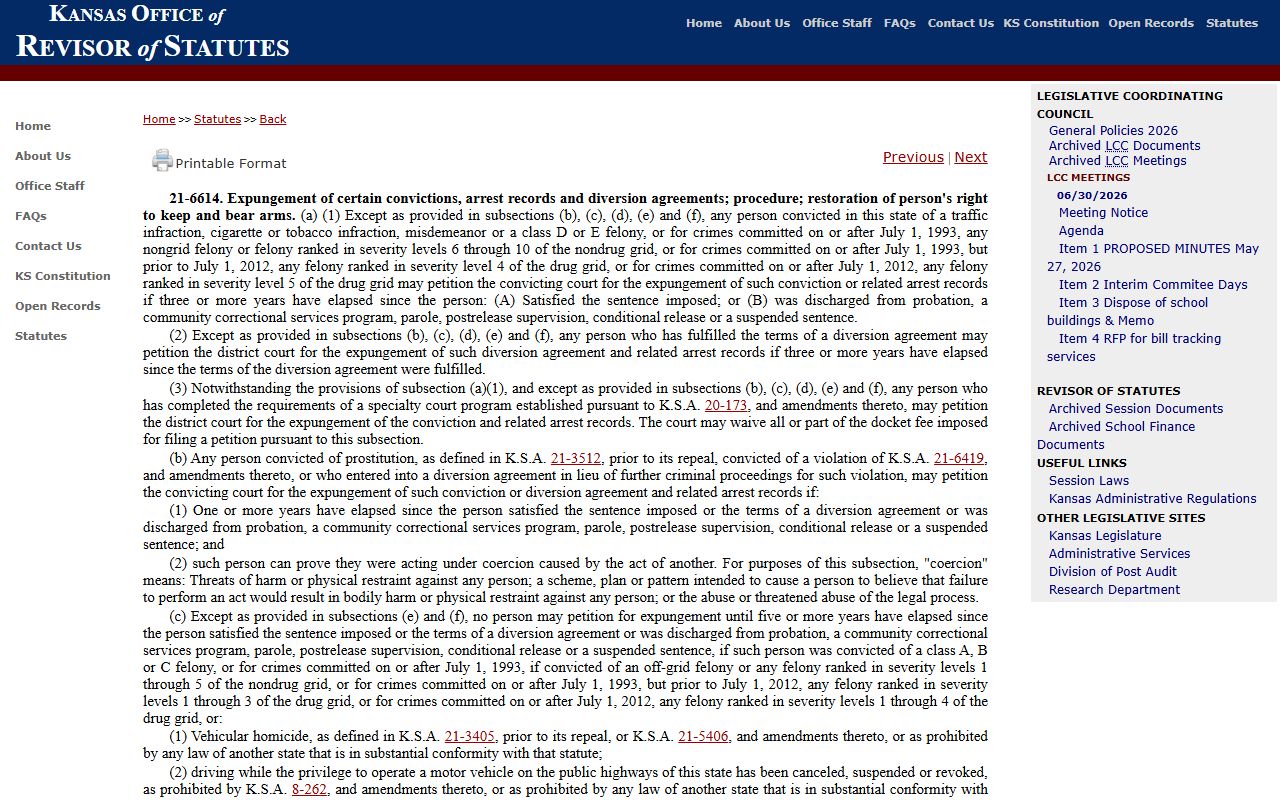
That statute should not be read as automatic eligibility. A Marshall County filing still depends on the case facts and the court's order.
Restricted Marshall County Criminal Records
Restricted criminal court records include juvenile offender matters, sealed cases, expunged records, protected personal identifiers, and documents a court has closed by rule or order. Kansas juvenile statutes in Chapter 38 Article 23 address juvenile offender record disclosure and expungement provisions. Public-facing copies should not expose Social Security numbers, account numbers, protected dates of birth, minor identifying information, medical information, or sealed content.
If a criminal court record cannot be found online, that does not prove the case does not exist. It may be sealed, confidential, expunged, too old for online display, not yet digitized, filed under a different name or case number, or held by a municipal or federal court instead of Marshall County District Court. The Clerk of the District Court can confirm the correct local request path.
Federal Criminal Case Records
Federal criminal cases are not held by the Marshall County Clerk of the District Court. Kansas federal cases are handled by the U.S. District Court for the District of Kansas and searched through PACER/CM/ECF. The federal court system has separate clerks, case numbers, access rules, and fee structures. A state arrest or county prosecution does not become a federal case unless a federal agency or federal court is involved.
The U.S. District Court for the District of Kansas page is one federal source for Kansas court contacts.
Marshall County criminal court records stay with Kansas District Court unless the prosecution is filed in federal court.
The U.S. Attorney's Office for the District of Kansas page is a prosecution source for federal cases.
That federal prosecution source is separate from the Marshall County Attorney and should not be used for ordinary county District Court case copies.
Marshall County Criminal Copies
The Marshall County Clerk of the District Court is the working records office for criminal court records filed in local District Court. The office is at 1201 Broadway, Office #5, P.O. Box 149, Marysville, Kansas 66508. The court lists phone 785-562-5301, fax 785-562-2458, shared email msdc@kscourts.org, and public hours Monday through Friday, 8:00 a.m. to 5:00 p.m.
Requests should identify the defendant, case number if known, approximate filing date, requested document, and whether a certified copy is needed. The request form allows the clerk to estimate charges and require prepayment. For probation supervision, presentence reports, bond supervision, or sentencing context, Marshall County Court Services and Community Corrections may appear in the case history, but the court file copy request still belongs with the clerk.
Marshall County Clerk of the District Court
1201 Broadway, Office #5
P.O. Box 149
Marysville, KS 66508
785-562-5301
Monday-Friday, 8:00 a.m. to 5:00 p.m.